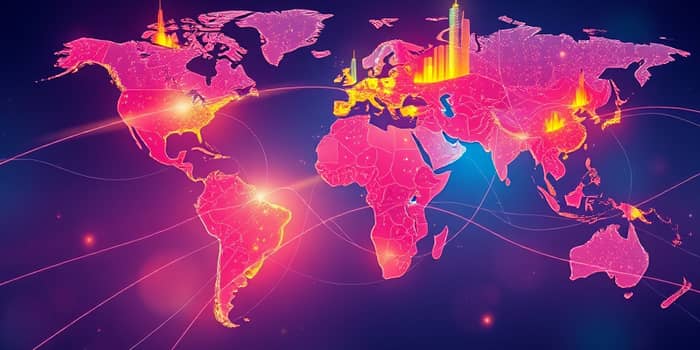
As the global economic landscape shifts, a new class of nations is poised to redefine prosperity and power. These "emerging giants" are driving unprecedented growth and opening fresh horizons for investment, innovation, and inclusive development.
From bustling metropolises to rural innovation hubs, these economies are harnessing demographics, technology, and policy reform to chart a transformational course. This article explores the rise of these dynamic markets, the sectors fueling their ascent, and practical strategies to engage with their momentum.
Defining the Emerging Giants
Once dominated by the G7 and the BRICs, global growth now hinges on a more diverse group. The EAGLEs—Emerging and Growth-Leading Economies—are set to contribute over half of the next decade's incremental GDP, outpacing developed markets by a wide margin.
These economies are characterized by robust expansion of labor forces and savings, strategic reforms, and large populations embracing modernization. The core cohort includes China, India, Brazil, Indonesia, South Korea, Russia, Mexico, Egypt, Taiwan, and Turkey—all sharing a common trajectory of accelerated growth.
Quantitative Projections: A New World Order
Global GDP (PPP-adjusted) is forecast to rise by approximately $41 trillion in the coming decade. Remarkably, the EAGLEs alone will account for more than 50% of this growth, leaving the G7 with roughly 14% of the incremental share.
China leads the pack with an anticipated $12.6 trillion contribution—nearly double that of the entire G7 combined. India and the United States each project about $3.6 trillion in new GDP, followed by Brazil ($1.1 trillion), Indonesia ($942 billion), and South Korea ($739 billion).
Over 250 million will join the global middle class within these economies, with China absorbing more than half of the new entrants. Such demographic shifts will reshape consumption patterns, labor markets, and urban development at an unparalleled scale.
Sectors Powering Tomorrow's Economies
Innovation and diversification are at the heart of the emerging giants' strategy. McKinsey identifies a suite of high-growth, high-dynamism sectors set to generate up to $48 trillion in revenue by 2030.
- AI-driven financial technology solutions: fintech, automation
- Renewable energy and green infrastructure: solar, wind, storage
- Advanced manufacturing and robotics: robotics, 3D printing
- Mobile eCommerce and digital marketplaces: platforms, mobile marketplaces
- Telemedicine and bioscience innovations: diagnostics, telehealth
These arenas not only promise commercial returns, but also drive social progress through job creation, environmental sustainability, and enhanced quality of life for growing urban populations.
Demographics, Urbanization, and the Middle Class
Rapid urban migration is fueling demand for housing, infrastructure, and services. City skylines from Shanghai to Sao Paulo are transforming in real time, reflecting soaring consumer aspirations.
More than 250 million new middle-class consumers across these economies will power markets for education, healthcare, and consumer goods. Businesses that understand local preferences and invest in adaptive distribution models can tap into this vast, evolving consumer base.
Opportunities and Risks for Businesses and Investors
The rise of emerging giants presents both promising opportunities and inherent risks. On one hand, early movers can secure market leadership in high-growth niches and leverage cost advantages. On the other hand, volatility, regulatory shifts, and geopolitical tensions require robust risk management frameworks.
- Opportunities: infrastructure projects, digital platforms, renewable energy investments
- Risks: currency fluctuations, policy reversals, supply chain disruptions
Practical strategies include conducting in-depth local market research, forming public-private partnerships, and aligning investments with sustainable development goals to enhance resilience and social license to operate.
Navigating the Geopolitical Landscape
As emerging giants gain clout, trade relationships and alliances are being reshaped. From bilateral partnerships to multilateral trade blocs, economic diplomacy will play a central role in balancing interests and mitigating tensions.
Investors and policymakers must monitor evolving regulatory environments, from data privacy laws to local content requirements, to stay ahead of potential barriers and foster constructive dialogue with host governments.
Building Bridges: Policy, Infrastructure, and Inclusion
Governments and development institutions must collaborate to address infrastructure gaps. Investment in transport networks, energy grids, and digital connectivity is essential for sustaining high growth rates.
Equally important is promoting inclusive growth. Policies that prioritize education, healthcare access, and vocational training will ensure broad-based benefits, reduce inequality, and cultivate the skilled workforce needed for tomorrow's challenges.
Conclusion: Embracing the Rise of Emerging Giants
The ascent of emerging giants represents a profound shift in global economic dynamics. For businesses, investors, and policymakers, these markets offer fertile ground for innovation, growth, and societal impact.
By understanding demographic trends, leveraging sectoral opportunities, and navigating policy landscapes with agility, stakeholders can participate in and contribute to a more balanced, dynamic world economy. Now is the time to embrace these new engines of global growth and write the next chapter of prosperity together.