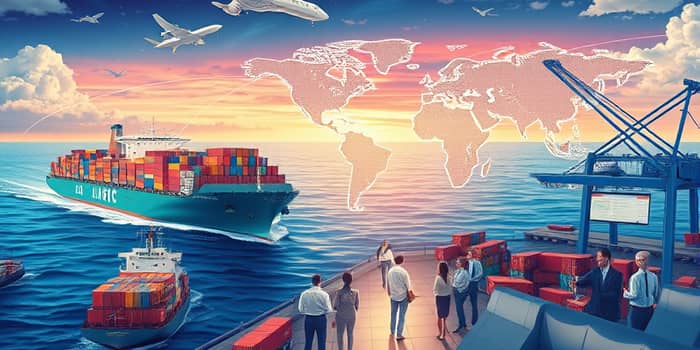
In 2025, global trade remains a complex tapestry of opportunity and risk. While geopolitical frictions and policy shifts pose challenges, the overall trajectory continues upward, driven by innovation and regional dynamism.
Resilient Growth Amidst Geopolitical Uncertainty
Despite rising protectionism and flashpoints across multiple regions, world trade recorded a net increase of about $500 billion in the first half of 2025. Quarterly data show goods trade expanding by 2.5%, while services rebounded from earlier contractions to a projected 4% growth in Q3.
The ability to adapt to shifting policies—tariffs, sanctions, or new agreements—has become a core competency for multinational firms. Supply chains are rerouting, inventory strategies are evolving, and digital platforms are enhancing transparency.
Robust despite persistent tensions, businesses are leveraging these shifts as opportunities to diversify sourcing and tap emerging markets. The consistent annualized growth of roughly 5% for goods and 6% for services underlines a resilient growth trajectory that defies short-term volatility.
Regional Dynamics: Asia’s Ascendance and Europe’s Challenges
Trade patterns are diverging sharply across regions. Developing economies, especially in Asia, are fueling much of the expansion, while some Western markets face headwinds.
- Asia: Malaysian imports climbed 13.2% to $248.5 billion, and Thailand’s imports rose 6.7% to $259.6 billion in early 2025. Asian export volumes could surge by up to 7.4% in 2024.
- Europe: Exports are forecast to contract 1.4% in 2024, though some importers like the UK saw an 8.5% uptick in Q2 of 2025.
- United States: After a 5% import increase in late 2024, Q2 2025 saw an 18.4% drop. Exports averaged $280.5 billion in July, with imports at $358.8 billion, pushing the trade deficit up by 30.9% year-to-date.
These divergences reflect both demand shifts and strategic responses to local policy. Asian producers are capitalizing on regional integration and competitive labor costs, while European firms are navigating energy price volatility and regulatory changes.
The Driving Forces: Manufacturing and Services
Manufacturing remains the primary engine of trade growth. Electronics, semiconductors, and the automotive sector—particularly hybrid and electric vehicles—are at the forefront.
Rising prices for raw materials and components have amplified the value of goods trade, especially in Q3. However, services are playing an increasingly vital role, from digital platforms to professional consulting, with annual growth near 6%.
Manufacturing-led expansion is complemented by the agility of services firms adapting to remote collaboration tools and cross-border digital delivery. This dual momentum helps companies smooth out sector-specific downturns and capture new revenue streams.
Policy Risks and Future Prospects
Looking ahead, uncertainty looms large. U.S. trade policy could introduce fresh tariffs, while rising geopolitical tensions—particularly in the Middle East—pose downside risks. Yet, monetary easing in key economies like China may shore up global demand.
- Protectionist measures are rising, but overall trade resilience remains strong.
- Monetary and fiscal policies will influence import demand across major economies.
- Geopolitical conflicts could accelerate supply chain diversification efforts.
Multinational corporations are developing contingency plans, from dual sourcing to onshoring critical production. Strategic flexibility in supply chains has become a competitive imperative.
The IMF projects a slowdown in global GDP growth to 3.2% in 2025, while the World Bank expects trade growth to moderate to 5.8%. Even with this tempered outlook, trade volumes remain well above pre-pandemic norms.
Charting a Path Forward
To thrive in this environment, businesses should focus on:
- Diversifying supply chains across stable and emerging markets.
- Investing in digital trade platforms and real-time analytics.
- Building cross-sector partnerships to mitigate single-market risks.
- Monitoring policy trends and adapting procurement strategies promptly.
By embracing data-driven decision making and fostering agile organizational structures, companies can transform uncertainty into opportunity. The evolving landscape of global trade in 2025 offers both challenges and tremendous potential for those prepared to navigate its shifting sands with vision and resilience.
References
- https://unctad.org/news/global-trade-25-second-quarter-track-record-highs-2025
- https://www.bea.gov/news/2025/us-international-trade-goods-and-services-july-2025
- https://unctad.org/publication/global-trade-update-october-2025-global-trade-remains-strong-despite-policy-changes-and
- https://www.census.gov/foreign-trade/
- https://www.wita.org/atp-research/trade-trends-2025/
- https://dataweb.usitc.gov
- https://www.oecd.org/en/data/insights/statistical-releases/2025/08/international-trade-statistics-trends-in-second-quarter-2025.html
- https://comtrade.un.org
- https://www.bea.gov/news/2025/us-international-trade-goods-and-services-june-2025
- https://www.imf.org/en/publications/weo/issues/2025/10/14/world-economic-outlook-october-2025
- https://www.worldbank.org/en/publication/global-economic-prospects