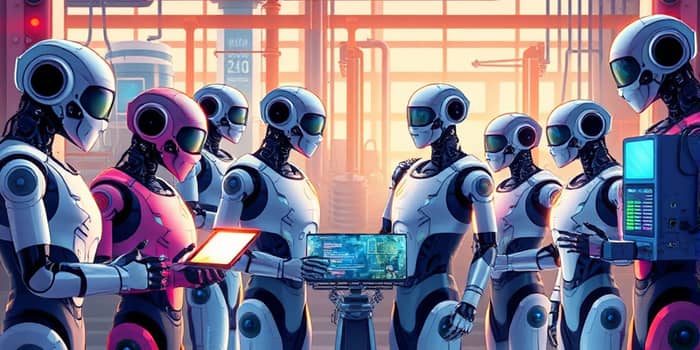
In an era defined by rapid technological advances, the rise of automation is reshaping industries, economies, and societies. The deployment of intelligent machines promises unprecedented productivity gains in manufacturing and a fundamental transformation in how we work. Yet, this revolution also raises complex questions about job displacement, social equity, and the policies needed to guide change. By understanding the data, trends, and practical strategies behind automation, businesses and individuals can navigate a future where humans and robots thrive together.
Market Growth and Scale
The global industrial automation market is on an extraordinary trajectory, projected to reach $226.8 billion in 2025, up from $206 billion in 2024, and forecast to hit $379 billion by 2030 at a 10.8% CAGR. Adoption is accelerating: by 2024, 60% of companies had implemented automation, a figure expected to grow to 85% by 2029. As firms harness digital tools, 91% report improved visibility into processes post-automation.
Asia-Pacific leads the charge, accounting for 39% of industrial automation revenue in 2024, while North America dominates financial process automation. In Q1 2025, North American manufacturers ordered over 9,000 new industrial robots, with collaborative robots (cobots) representing 11.6% of these orders. This rapid uptake underscores a broader shift toward interconnected, data-driven factories.
Productivity, ROI, and Cost Effects
Automation has delivered massive efficiency boosts in established economies. Since 1990, U.S. manufacturing output rose 71.8%, even as employment declined 30.7%. Over the same period, labor productivity soared 140.1%. Robotic process automation (RPA) compounds these gains, generating 30%–200% ROI in the first year, and driving the business process automation market from $13 billion in 2024 to an estimated $23.9 billion by 2029 at an 11.6% CAGR.
Forecasts suggest that robots could quadruple by 2025, potentially curbing U.S. wage growth by 2% and trimming the employment ratio by one percentage point. Yet, the upfront costs are frequently offset by long-term savings, streamlined workflows, and higher-quality outputs.
Job Displacement vs. Creation
Automation has undeniable human impacts. In manufacturing alone, 1.7 million jobs have vanished since 2000, with 360,000–670,000 U.S. positions lost specifically to robots. Technological change, rather than trade, explains 87% of these losses from 2000 to 2010. Still, the macro outlook balances this disruption: by 2030, 92 million jobs may be displaced, but 170 million new roles will emerge, yielding a net gain of 78 million jobs.
- Each additional robot per 1,000 U.S. workers reduces wages by 0.42% and cuts the employment-population ratio by 0.2 points.
- At the local level, one robot can eliminate six jobs in its commuting zone; nationally, it costs about 3.3 jobs.
- Routine and middle-class occupations face the greatest risk, while roles demanding creativity and machine interaction grow.
The World Economic Forum projects that 85 million jobs could vanish by 2025, yet 97 million new positions will be created, particularly in technology, data analysis, and human-machine collaboration.
Sector and Occupation-Specific Trends
Different industries experience automation in unique ways. In construction, advanced robotics could eliminate 498,000 jobs and $45.4 billion in U.S. output over 40 years. The Bureau of Labor Statistics foresees 814,100 additional manufacturing job losses in the coming decade.
Conversely, sectors like healthcare, retail, legal services, and transportation face both risks and opportunities. Marketing automation—projected to grow from $5.65 billion in 2024 to $14.55 billion by 2031—free employees from repetitive tasks, enabling focus on strategy and creativity. The automotive industry saw a 42% surge in robot orders and a 78% jump in value, driven by OEM investments. Cobots, designed to work alongside humans, are now commonplace in logistics, electronics, and precision assembly.
Societal and Economic Impacts
Automation yields profound societal changes. Industries with high AI adoption enjoy wage growth twice as fast as others, and revenue per employee can grow threefold. By offloading routine duties, workers shift to higher-value strategic activities, fostering innovation and job satisfaction.
- 82% of IT professionals are expanding automation capabilities; 66% of businesses automate at least one process.
- Approximately 70% of digital transformation projects fall short of objectives due to inadequate change management.
- Balanced policies and reskilling programs are critical to address labor market polarization and wage inequality.
Policymakers and businesses are ramping up workforce training, but the pace of technological change demands a coordinated response to minimize disruption and maximize societal benefit.
Technologies Driving the Revolution
The automation ecosystem is fueled by a suite of advanced technologies, each amplifying the others. Hyperautomation and AI integration are at the forefront, but they rely on robust data streams and connectivity.
- Artificial Intelligence (including generative AI models)
- Industrial Internet of Things (IIoT) and edge computing
- Cloud platforms, collaborative robots (cobots), and robotic process automation (RPA)
- Machine Learning for predictive insights and adaptive control
By 2025, hybrid environments blending cloud and edge solutions will enable real-time decision-making on the factory floor, while hyperautomation will weave AI, ML, and RPA into seamless workflows.
Future Projections and Conclusion
Looking ahead, 92% of companies plan to boost AI investments over the next three years. The robotics revolution has already surpassed early predictions, driven by generative AI’s ability to accelerate design, quality control, and maintenance.
Yet technological prowess alone is not enough. To harness the full promise of automation, stakeholders must champion balanced policies and reskilling programs, foster collaboration between human and machine, and prioritize ethical frameworks that uplift communities. As we stand on the brink of a new industrial epoch, the question is not whether automation will define our future—but how we will shape it.
References
- https://www.oxfordeconomics.com/resource/ai-and-robots-in-2025-the-robotics-revolution-we-predicted-has-arrived/
- https://www.ncci.com/Articles/Pages/II_Insights_QEB_Impact-Automation-Employment-Q2-2017-Part1.aspx
- https://thunderbit.com/blog/automation-statistics-industry-data-insights
- https://www.venasolutions.com/blog/automation-statistics
- https://mitsloan.mit.edu/ideas-made-to-matter/a-new-study-measures-actual-impact-robots-jobs-its-significant
- https://psglobalconsulting.com/blog/2025-workflow-automation-trends-key-statistics-and-insights-for-success
- https://www.brookings.edu/articles/understanding-the-impact-of-automation-on-workers-jobs-and-wages/
- https://explodingtopics.com/blog/ai-replacing-jobs
- https://www.stlouisfed.org/publications/regional-economist/second-quarter-2019/rise-automation-robots
- https://www.mckinsey.com/capabilities/tech-and-ai/our-insights/superagency-in-the-workplace-empowering-people-to-unlock-ais-full-potential-at-work
- https://www.weforum.org/press/2020/10/recession-and-automation-changes-our-future-of-work-but-there-are-jobs-coming-report-says-52c5162fce/
- https://www.pwc.com/gx/en/services/ai/ai-jobs-barometer.html
- https://www.bls.gov/opub/mlr/2022/article/growth-trends-for-selected-occupations-considered-at-risk-from-automation.htm
- https://www.rockwellautomation.com/en-us/company/news/the-journal/8-key-industrial-automation-trends-in-2025.html
- https://www.imf.org/en/blogs/articles/2024/01/14/ai-will-transform-the-global-economy-lets-make-sure-it-benefits-humanity