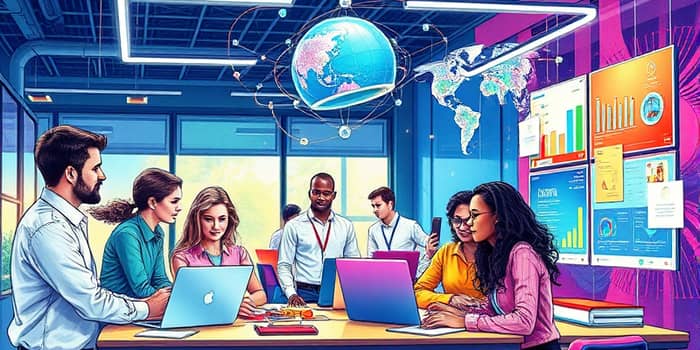
In 2025, the landscape of employment is undergoing a profound shift, driven by rapid technological advances, demographic changes, and global economic forces. Organizations and individuals alike must navigate an environment where adaptability and continuous learning are paramount.
This article explores how businesses are evolving into frontier firms, how human-AI partnerships are reshaping roles, and what strategies can empower workers to thrive in the decades ahead.
The Emergence of the Frontier Firm
The concept of the frontier firm captures a new paradigm in which enterprises blend AI and human judgment to drive decision-making at scale. Leaders view 2025 as a watershed year, with 82% agreeing on the need to rethink core operations and talent deployment.
Characterized by extraordinary agility and rapid expansion, these firms elevate productivity by embedding AI in every workflow, ensuring that every decision is informed by real-time data and human insight.
- Rapid scaling through automated processes
- Agile structures that respond to market shifts
- Enhanced value generation from data-driven insights
Human-AI Integration
As organizations refine the roles of AI agents, workers step into new responsibilities as “agent bosses,” balancing creative judgment with algorithmic precision. Understanding the optimal human-agent ratio becomes vital to maintain both efficiency and empathy in customer interactions.
Yet challenges persist. Companies must balance automation with human interaction to nurture employee engagement, avoid dehumanizing customer service, and promote trust in AI recommendations. Training programs that develop both technical proficiency and emotional intelligence will distinguish future-ready talent pools.
Global Talent Acquisition and Mobility
International hiring has transitioned from niche practice to default strategy. More than half of business leaders plan to increase expanding cross-border talent pools globally within the next year as they seek specialized skills, cultural diversity, and cost efficiencies.
Employees now expect geographic flexibility, embracing “work from anywhere” as a key benefit. This trend raises new imperatives in tax compliance, legal frameworks, and local policy management.
- Filling critical skill gaps in remote markets
- Diversifying teams to spark innovation
- Reducing overhead through strategic hires
Compensation and Pay Transparency
With pay transparency laws proliferating worldwide, organizations are adopting global frameworks that promote fair salaries and local competitiveness. Modern compensation models leverage benchmarking tools and inflation-adjusted calculators to sustain equity across regions.
Employees demand clarity around salary determinants, linking transparency to higher job satisfaction and reduced turnover. Companies that proactively share compensation philosophies build stronger employer brands and foster trust across remote and hybrid teams.
Reskilling for an AI-Driven World
The World Economic Forum warns that 1 billion people worldwide need to be reskilled by 2030. Despite this urgency, only 17% of companies are boldly investing in comprehensive upskilling programs. As 39% of current skill sets face obsolescence by 2030, proactive learning pathways become critical.
Out of every 100 workers, 59 will need training in the coming years:
Organizations can bridge this gap through modular e-learning, AI-driven coaching, and project rotations that reinforce both technical and leadership competencies.
Job Creation and Displacement Trends
Structural shifts in the labor market will affect 22% of today’s jobs between 2025 and 2030, with a net gain of 7% (78 million new roles). While 92 million positions may be displaced, 170 million new opportunities will emerge in fields like care, education, and sustainable technologies.
Frontline occupations such as delivery drivers and construction workers will grow alongside technologically oriented roles in cybersecurity, data analysis, and AI maintenance. Building employee resilience and adaptability will be key to capturing these new horizons.
Diversity, Equity, and Inclusion
DEI initiatives have surged, with 83% of employers reporting active programs, up from 67% in 2023. Leaders recognize diverse teams as a catalyst for creativity and market understanding, integrating inclusive design principles across every workflow.
- Improved innovation through diverse perspectives
- Broader talent pipelines and retention
- Enhanced employee engagement and satisfaction
Fostering neuroinclusive environments, sustainable policies, and equitable leadership pathways cements a culture of belonging, driving performance and social impact in equal measure.
Building Future-Ready Organizations
To thrive in this new era, companies must skills-based approach to talent management, connecting employees with emerging projects and flattening hierarchies for agility. Intelligent platforms can match skills to opportunities, helping workers navigate fluid career paths.
Benefits are consolidating into integrated, flexible benefits platform designs that adapt to individual needs, from mental health support to lifelong learning stipends. Embracing building sustainable workplaces that integrate social responsibility will differentiate the employers of choice for next-generation talent.
Ultimately, businesses that flatten organizational hierarchies for agility and leverage AI to foster human creativity will lead the global economy. By investing in continuous learning, transparent practices, and diverse cultures, organizations can unlock the full potential of their workforce and shape a brighter future of work.
References
- https://futureworkseries.com/future-of-work-usa-2025
- https://remote.com/blog/global-hr/global-workforce-trends
- https://www.greatplacetowork.com/resources/blog/7-workplace-trends-to-watch-for-2025
- https://www.weforum.org/publications/the-future-of-jobs-report-2025/digest/
- https://www.mercer.com/insights/people-strategy/future-of-work/global-talent-trends/
- https://www.dhrglobal.com/insights/workforce-trends-report-2025/
- https://www.top-employers.com/us/world-of-work-trends-2025-the-collective-workforce/
- https://www.adpresearch.com/release/people-at-work-2025-a-global-workforce-view/
- https://www.pwc.com/gx/en/issues/workforce/hopes-and-fears.html
- https://www.weforum.org/publications/the-future-of-jobs-report-2025/
- https://www.gensler.com/gri/global-workplace-survey-2025
- https://www.shrm.org/topics-tools/news/all-things-work/will-workplace-look-like-2025
- https://www.deloitte.com/global/en/issues/work/genz-millennial-survey.html