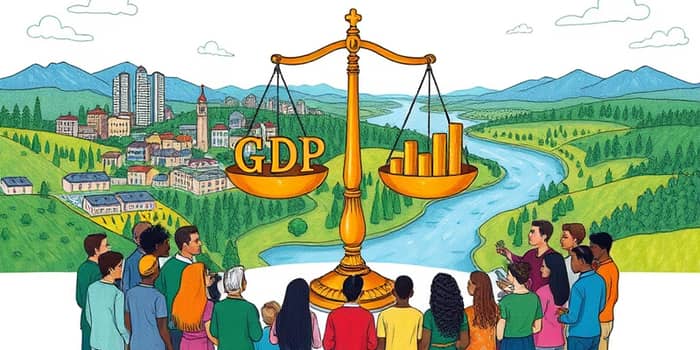
Gross Domestic Product, commonly known as GDP, has long been the cornerstone of economic analysis. By capturing the total monetary value of all final goods produced within national borders, policymakers and researchers have both celebrated and critiqued its clarity and limitations.
As global challenges intensify—from climate crises to widening social divides—questions arise about whether mere output can capture real human progress. Today, economists, activists, and citizens are asking: how do we measure what truly matters?
This article explores why GDP remains entrenched in policy discussions, uncovers its blind spots, and highlights emerging frameworks that aim to quantify what truly matters for societies and ecosystems. From the unmeasured toil of caretakers to the invisible costs of environmental damage, we chart a path toward multidimensional welfare measurement frameworks that capture the richness of human progress.
Why GDP Remains Dominant
Since its inception in the early twentieth century, GDP has been prized for its objectivity, comparability, and timeliness. Governments rely on regular GDP reports to guide fiscal strategies, while central banks adjust interest rates based on quarterly growth figures.
International organizations, including the World Bank and IMF, use GDP data to assess creditworthiness, allocate funding, and negotiate trade deals. Even in low-income countries, GDP per capita and purchasing power parity (PPP) data serve as shorthand for living standards—despite the fact that PPP only corrects for cost-of-living differences without addressing distributional or non-market factors.
Beyond technical merits, GDP’s dominance also stems from cultural reinforcement. Media headlines and political slogans celebrate GDP milestones as badges of national success, encouraging policymakers to focus on growth figures above all else. This narrow focus can sideline investments in education, mental health, or ecological restoration that yield significant but less quantifiable returns.
The Shortcomings of GDP
Despite its ubiquity, GDP exhibits critical weaknesses that must be acknowledged to foster more inclusive policy choices. At its core, GDP is an output measure, blind to how benefits and burdens are distributed, or whether long-term risks accumulate outside market transactions.
- Non-market contributions: Activities such as unpaid household and volunteer work generate value but remain invisible in GDP tallies. In many developing regions, large informal sectors also evade formal economic surveys, understating the vitality of local exchange.
- Environmental costs: Production increases GDP even when it implies environmental degradation and resource depletion. Cleanup expenditures after disasters boost economic activity, but mask the loss of natural capital and ecosystem services.
- Quality of life: Leisure time, health outcomes, and cultural engagement lie beyond the scope of GDP. Measures like work-life balance or social cohesion profoundly affect well-being, yet they elude simple price tags.
- Income inequality: Aggregate per-capita figures hide disparities. Two nations with similar GDP per person can exhibit income inequality and social disparities so stark that living realities diverge dramatically.
- Negative externalities: Pollution, congestion, and stress-related healthcare spur spending that counts as "growth" even as they indicate eroding quality of life.
- Measurement challenges: Assigning monetary values to subsistence farming or caregiving is complex, leading to inconsistent comparisons and gender biases in official data.
These blind spots undermine GDP’s capacity to capture the full spectrum of human welfare. When recovery efforts or pollution cleanup inflate GDP figures, genuine prosperity may be in retreat—even as the headline numbers rise.
Moreover, the failure to record informal labor and unpaid care work disproportionately affects women. Globally, it is estimated that household and community contributions could increase measured economic activity by up to 20%, yet they remain absent from traditional statistics. This gap skews resource allocation and obscures the true drivers of social well-being.
Alternative Indicators Shaping a New Vision
To address these shortcomings, a range of complementary metrics has emerged. These indicators integrate economic, environmental, and social dimensions, offering a more nuanced portrait of national well-being.
- Human Development Index (HDI): Combines life expectancy, education attainment, and per-capita income into a normalized score. Norway leads with an HDI of 0.961, while Niger remains at 0.394, underscoring stark global differences.
- Genuine Progress Indicator (GPI): Adjusts GDP by subtracting costs such as pollution and crime, while adding positives like volunteer work. For the United States, GPI per capita estimates are often 20–30% lower than GDP after accounting for externalities.
- OECD Better Life Index: Assesses eleven domains including housing, community, and civic engagement, allowing citizens to weigh the aspects of life they value most.
- Gross National Happiness (GNH): Bhutan’s framework integrates psychological well-being, cultural resilience, and ecological diversity into policy goals.
- Social Progress Index (SPI): Focuses on basic human needs, foundations of well-being, and opportunity, decoupling social outcomes from pure income measures.
- Inclusive Wealth Index (IWI): Calculates the value of produced, human, and natural capital to gauge long-term sustainability of national wealth.
Each of these tools highlights dimensions that GDP overlooks. The HDI emphasizes education and health; GPI translates environmental degradation into economic terms; SPI spotlights social infrastructure; and GNH underscores cultural and psychological factors. Together, they challenge governments to redefine what constitutes progress.
Policy Implications and the Path Forward
Recognizing the limitations of GDP requires policymakers to embrace a richer set of targets and mechanisms that foster equitable and sustainable growth. Embedding multidimensional metrics into fiscal and social policies can transform priorities at every level of government and community.
- Progressive taxation: Enhancing redistribution to mitigate income gaps and social disenfranchisement, ensuring that economic gains benefit the broader population.
- Investment in public goods: Prioritizing education, healthcare, and green infrastructure that build human and natural capital in the long term.
- Well-being budgeting: Integrating alternative indices into budgetary decisions to align spending with social and environmental objectives rather than pure output goals.
- International cooperation: Advocating for standardized data collection on non-market activities and natural assets to improve global comparisons and policy coordination.
Practical steps include pilot programs that allocate grant funding based on GPI improvements, or local governments measuring life satisfaction alongside revenue forecasts. Nations such as New Zealand have already introduced well-being budgets that factor in mental health, climate resilience, and indigenous rights.
Ultimately, measuring what matters most compels societies to look beyond quarterly GDP figures and craft policies that safeguard both people and planet. By embracing comprehensive multidimensional welfare measurement, we can redefine success and unlock pathways to a more just and sustainable future.
The journey toward better metrics is not merely technical—it is deeply political and ethical. It demands public engagement, robust data systems, and a willingness to challenge entrenched priorities. Yet if the price of progress is to reduce our world to a single digit, the reward is far greater: a society that values well-being over mere production.
References
- https://fiveable.me/honors-economics/unit-8/limitations-gdp-measure-well-being/study-guide/Ztzpad6BU5hWQuY6
- https://fiveable.me/ap-macro/unit-2/limitations-gdp/study-guide/xYa8DhAJn3p8qzYrgZLF
- https://www.globalpolicyjournal.com/blog/05/08/2025/alternative-conceptual-framework-gdp-measuring-well-being-interview-james-k-boyce
- https://climate.sustainability-directory.com/question/what-are-limitations-of-current-gdp/
- https://www.visionofhumanity.org/the-problem-with-gdp/
- https://corporatefinanceinstitute.com/resources/economics/gross-domestic-product-limitations/
- https://www.imf.org/en/publications/fandd/issues/2021/12/measuring-essence-good-life-benjamin-cooper-heffetz-kimball
- https://www.imf.org/en/publications/fandd/issues/series/back-to-basics/gross-domestic-product-gdp
- https://www.khanacademy.org/economics-finance-domain/ap-macroeconomics/economic-iondicators-and-the-business-cycle/limitations-of-gdp/a/lesson-summary-the-limitations-of-gdp
- https://fscj.pressbooks.pub/macroeconomics/chapter/limitations-of-real-gdp/
- https://hbr.org/2019/10/gdp-is-not-a-measure-of-human-well-being
- https://courses.lumenlearning.com/hccs-macroeconomics-3/chapter/shortcomings-of-gross-domestic-product/
- https://www.worldfinance.com/strategy/why-gdp-is-no-longer-the-most-effective-measure-of-economic-success