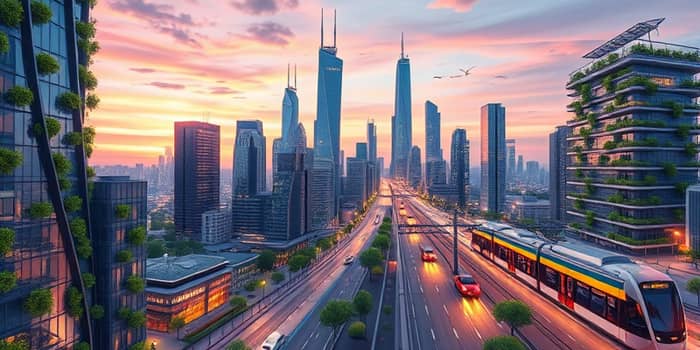
In a world where more than half the population now lives in urban areas, cities are evolving at breathtaking speed. The confluence of technology, policy, and human aspiration is reshaping skylines and redefining opportunity. Investors and urban planners stand at the threshold of a new era, where city streets hum with data and buildings breathe with intelligence.
As the global smart city market soars from USD 634.8 billion in 2024 toward a projected USD 3,295.4 billion by 2035, the promise of transformative urban landscapes powered by innovation has never been clearer. This article explores the trends, technologies, and strategies that will drive sustainable, inclusive, and profitable urban futures.
Understanding the Smart City Revolution
At its core, a smart city leverages digital connectivity and data analytics to optimize resource use, enhance public services, and enrich quality of life. From adaptive traffic signals to AI-managed waste collection, these systems are interconnected through sensors, networks, and platforms.
Global projections reveal the scale of this transformation:
- Overall market value: USD 634.8 billion in 2024, rising to USD 3,295.4 billion by 2035 (CAGR 16.15%).
- Urban mobility alone: Expected to hit USD 250 billion by 2030 (CAGR 8.45%).
- Smart buildings: Growing from USD 111.5 billion in 2025 to USD 277.9 billion by 2034 (CAGR 10.7%).
Key Investment Drivers Shaping the Market
Several core forces are propelling cities toward digital transformation, creating unprecedented investment opportunities across sectors:
- Sustainable urban development: Rapid urbanization demands efficient energy, water, and land use, fostering a surge in green infrastructure.
- Quality of life improvements: Public safety systems, real-time transit updates, and smart healthcare platforms enhance daily living.
- Government initiatives: National missions like India’s Smart Cities Mission and Singapore’s Green Plan 2030 galvanize public funding and policy support.
- Private sector momentum: Venture capital and corporate R&D are fueling breakthroughs in AI, IoT, and mobility services.
Innovative Technologies Transforming Urban Spaces
From the pavement to the pole, technology is woven into the urban fabric. Key breakthroughs include:
AI-Driven Urban Mobility: Pittsburgh’s SURTRAC system cuts travel times by 25% and emissions by 20%, while Helsinki’s Whim multimodal app reduced private car use by 38%. These successes demonstrate how real-time analytics and machine learning can optimize traffic flows and shift rider habits.
5G/6G and IoT Connectivity: With cellular IoT links growing at nearly 18% annually, cities can deploy massive sensor networks that monitor air quality, energy consumption, and infrastructure health in real time.
Smart Buildings and Infrastructure: AI-enabled controls can slash building energy use by up to 40%. In Singapore, 80% of structures are slated for green certification by 2030, while Masdar City in the UAE exemplifies net-zero ambition through solar arrays and waste-to-energy systems.
Digital Twins: Virtual models simulate real-world systems—from traffic patterns to power grids—enabling predictive maintenance, scenario planning, and crisis response.
Regional Insights: Mapping Opportunities Around the Globe
Geography shapes smart city strategies. North America leads with robust public–private partnerships and advanced wireless rollouts, while Asia-Pacific boasts rapid adoption driven by China, Japan, South Korea, and India.
Europe emphasizes stringent data privacy and green standards, supported by regional funding under the EU’s Horizon programs. The Middle East accelerates innovation through high-impact city projects in Dubai and Abu Dhabi, focusing on climate adaptation and tourism. Latin America’s fastest-growing hubs, such as São Paulo and Mexico City, prioritize crime reduction and transport efficiency.
Balancing Risk and Reward: Challenges Ahead
Despite dazzling prospects, stakeholders must navigate complex risks to ensure inclusive and equitable city development:
- Digital inequality: Unequal access to connectivity risks leaving vulnerable communities behind.
- Policy volatility: Shifts in funding priorities can stall or cancel large-scale projects.
- Data privacy and security: Massive data flows demand robust governance and cyber-resilience frameworks.
- Climate resilience: Scaling solutions for floods, heatwaves, and storms remains an urgent research frontier.
Charting a Course: Strategies for Investors and Cities
To capitalize on this momentum, stakeholders should adopt a structured approach:
Begin with thorough due diligence, examining regulatory landscapes, local needs, and technological maturity. Foster partnerships between municipalities, research institutions, and private firms to share risks and amplify impact. Embrace inclusive planning processes that engage community groups, ensuring solutions address real-world challenges.
Focus investment across hardware (sensors, EV chargers), software (analytics platforms, digital twins), and service models (mobility-as-a-service, urban farming). Prioritize projects with clear scalability and measurable social benefits, such as reduced emissions, lower crime rates, or improved public health.
Vision for Tomorrow: Beyond 2025
Looking ahead, the next decade promises cutting-edge digital twin technology driving real-time urban management, fleets of autonomous shuttles weaving through smart corridors, and driving sustainable resource management strategies via peer-to-peer energy trading in microgrids.
Vertical farms nestled in skyscraper atriums will supply fresh produce, while AI-powered disaster-response networks will predict and mitigate extreme weather. Together, these advances herald a new chapter of accelerating at an unprecedented compound annual rate urban evolution—one where technology and humanity converge for the greater good.
By embracing innovation with foresight and empathy, policymakers and investors can ensure our cities remain vibrant, resilient, and healthy. The journey to build smarter urban futures is complex, but the rewards—for economies, societies, and the planet—are immeasurable.
References
- https://www.sphericalinsights.com/blogs/top-45-smart-city-companies-to-watch-in-2025-market-intelligence-investment-trends-2024-2035
- https://www.startus-insights.com/innovators-guide/emerging-smart-city-trends/
- https://www.smartcitiesdive.com/news/smart-cities-trends-2025-transportation-climate-housing-tech/736836/
- https://www.telefonica.com/en/communication-room/blog/smart-cities-trends-shape-urban-future/
- https://cssh.northeastern.edu/6-smart-cities-trends-to-watch-in-2025/
- https://www.capgemini.com/insights/expert-perspectives/trends-in-2025-for-smart-cities/
- https://www.oecd.org/en/events/2025/10/5th-oecd-roundtable-on-smart-cities-and-inclusive-growth.html